
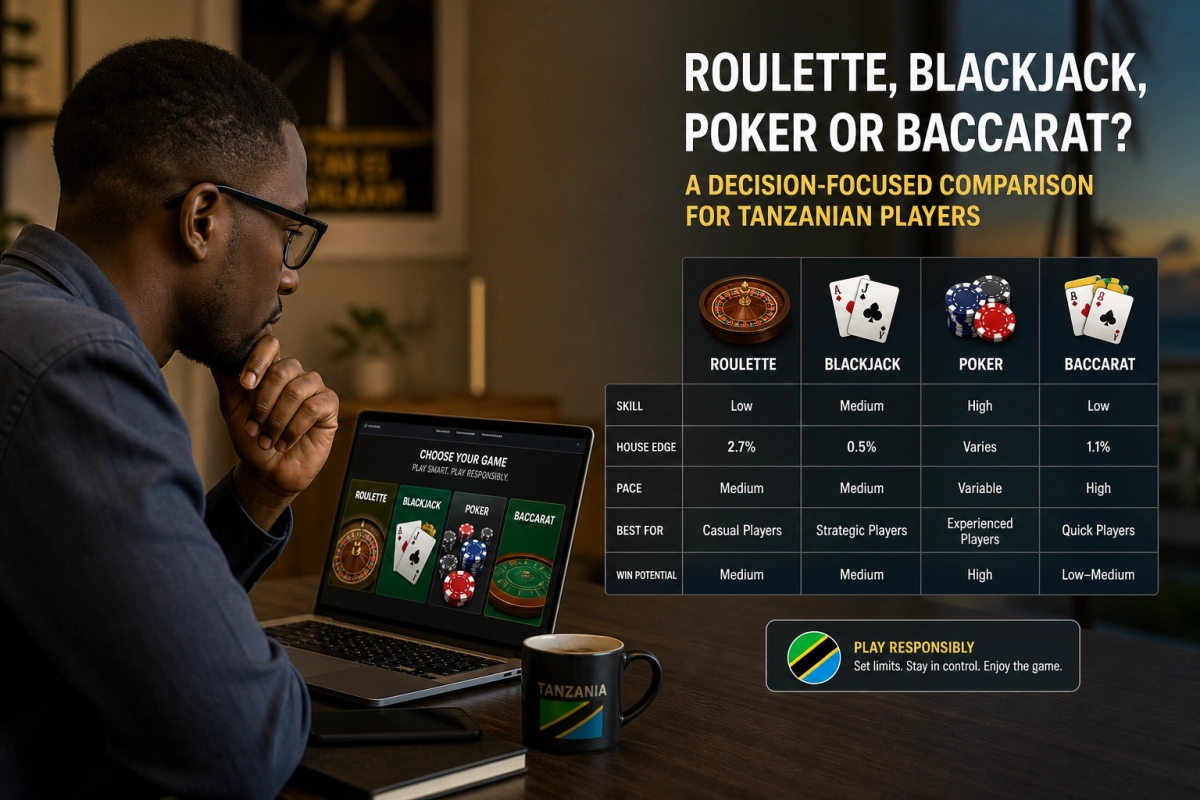
Choosing between roulette, blackjack, poker and baccarat for Tanzanian online casino players
This guide helps online casino players in Tanzania decide which table game best fits their goals. It compares roulette, blackjack, poker and baccarat on the decision factors that matter: house edge, variance (volatility), required skill, time per hand, betting options and practical bankroll advice. Readers will learn quick definitions, realistic expectations and simple rules to choose a game that matches their budget and play style.
Key concepts every player should know before choosing a game
Understanding a few technical terms makes comparisons useful:
- House edge — the long-term percentage of each bet the casino expects to keep. Lower is better for the player.
- Variance (volatility) — how bumpy results are in the short term. High variance means big swings; low variance gives steadier outcomes.
- Skill vs. luck — some games (poker) reward long-term skill; others (roulette, baccarat) are mostly chance with limited decision impact.
- Time-per-hand — how many decisions or rounds you can play per hour. Fast games consume bankroll quicker.
Quick comparison by the numbers and player effort
Below are practical summary points a Tanzanian reader can use when choosing a table.
Roulette — simple, fast, and variance-heavy
- Main objective: Predict where the ball lands on the wheel.
- Variants: European (single zero) and American (zero and double zero).
- House edge: European ~2.70%; American ~5.26%.
- Betting options: Inside bets (single number, 35:1 payout), outside bets (red/black 1:1, odd/even, dozens).
- Variance: High on single-number bets; outside bets lower variance but still riskier than many card games.
- Time: Quick rounds — many spins per hour.
Blackjack — decision-rich, lower house edge with correct play
- Main objective: Beat the dealer by getting closer to 21 without busting.
- Key rules: Hit, stand, double down, split, surrender; dealer follows fixed rules.
- House edge: With basic strategy commonly 0.5%–1% depending on rules.
- Skill: Basic strategy substantially reduces house edge; advanced techniques (card counting) are restricted and not a guaranteed method.
- Variance: Moderate — decisions reduce swings compared with roulette.
- Time: Medium pace depending on live or virtual tables; fewer “hands” per hour than roulette.
Concrete bankroll guidelines for responsible play
Use these simple multipliers based on a player’s chosen base unit (the typical bet size they are comfortable risking):
- Roulette — outside bets (red/black): bankroll ≈ 100× base bet. Single-number straight bets: bankroll ≈ 500× base bet because of very low hit probability.
- Blackjack — bankroll ≈ 50–100× base bet when using basic strategy (lower variance than roulette).
- Baccarat — banker bet is lower variance: bankroll ≈ 100× base bet; avoid tie bets (very high house edge).
- Poker (cash games) — treat bankroll in buy-ins: 20–50 full buy-ins for cash games; tournaments typically require 50–100 buy-ins depending on skill and variance.
These are conservative starting points for recreational play and assume no attempt to “beat” the house mathematically. Next, the guide will look game-by-game at decision points, common mistakes and practical examples of how a Tanzanian player can apply basic strategy and bet sizing in live online casino sessions.
Game-by-game decision points and common mistakes
Below are the key on-table decisions and the errors players most often make for each game. These points will help you focus practice where it matters.
- Roulette — where to place your risk: Decide between inside bets (high payout, low hit rate) and outside bets (low payout, steadier swings). Common mistakes: using progressive systems like Martingale without an adequate bankroll or stop-loss, and confusing short losing streaks with “due” numbers. Practical tip: stick to flat bets on outside options if you want longer sessions and predictable variance.
- Blackjack — follow basic strategy and manage deviations: Decision points are clear: hit/stand, double down, split, surrender. Mistakes: failing to learn basic strategy for the specific table rules (number of decks, dealer hits/stands on soft 17), and overusing side moves (splits/doubles) in the wrong situations. Practical tip: print or memorize a basic-strategy chart for the rule set of the table you join; use flat betting sized to your bankroll and only increase bet size with clear advantage (rare in online play).
- Poker — discipline, position and hand selection: Poker is skill-heavy: preflop selection, position awareness, pot control and reading opponents matter most. Mistakes: playing too many hands, ignoring stack sizes and table dynamics, and misjudging opponents in anonymous online tables. Practical tip: for cash games, pick lower stakes to build experience; track win-rate and variance so you don’t over-extend your bankroll.
- Baccarat — simplicity demands restraint: Bets are straightforward (banker, player, tie). Mistakes: chasing tie bets (very poor value) and switching bet sizes based on short streaks. Practical tip: favor banker bets (slight house edge advantage) with flat stakes and accept that short-term swings are normal.
Practical session examples and bet-sizing for Tanzanian players
Here are two realistic session plans showing how to apply the bankroll multipliers and manage time and variance during a playing session.
- Conservative one-hour roulette session (outside bets): You choose a base bet of 2,000 TZS. Recommended bankroll ≈ 100× base bet = 200,000 TZS. Expect ~60–100 spins per hour. Use flat 2,000 TZS bets on red/black or dozens. Set a stop-loss of 20% of the bankroll (40,000 TZS) and a modest win target (40,000 TZS). This keeps variance tolerable and avoids ruin from a short run of bad luck.
- Moderate blackjack session using basic strategy: Base bet 5,000 TZS with bankroll ≈ 50× base bet = 250,000 TZS. Expect ~50–80 hands per hour online depending on table speed. Play flat bets; only consider a small step-up (1.5–2× base) after a clear win stretch, and always revert to base after any loss. Memorize basic strategy for the table rules; avoid side bets which increase house edge.
For poker cash games, treat bankroll as buy-ins: if a typical cash table buy-in is 20,000 TZS, keep 20–50 full buy-ins (400,000–1,000,000 TZS) depending on skill and desired risk level. For baccarat, treat it like roulette outside bets: use 100× base bet and avoid ties. Across all games, a flat-betting approach, pre-set session limits and realistic time-per-hand expectations are the simplest ways to preserve bankroll and enjoy longer play.
Final guidance and next steps
Deciding which table game to play comes down to your goals, how much time and practice you’ll commit, and how much variance you can tolerate. Use the rules and bankroll rules you’ve read here as a starting framework, then adapt them to your personal limits and experience. The safest path is gradual: learn, practice, and scale only after you consistently meet your session goals without chasing losses.
Practical next steps for a safe, enjoyable experience
- Choose one game to learn well — focus on rules, common mistakes and the simple strategies that reduce house edge or variance.
- Use demo or low-stakes tables to practice decisions and timing before risking meaningful sums.
- Set clear session rules: bankroll allocation, flat-betting plan, stop-loss and win targets, and a time limit.
- Track results and adjust bankroll multipliers only after reviewing several sessions, not based on single outcomes.
- Prioritize licensed operators, secure payment methods and transparent terms so your play is both legal and protected.
- Keep gambling recreational: if it stops being enjoyable, take a break and consider setting deposit limits or seeking support.
Follow these steps, stay disciplined, and treat play as entertainment rather than income. That approach gives you the best chance to enjoy online casino games responsibly while protecting your funds and well-being.