
Understanding Slots Payout Strategies Through RTP, Volatility and Hit Frequency
Slots payout strategies are not systems that guarantee profit. Instead, they involve understanding how a slot’s mathematics affects potential returns, the frequency of payouts and the pressure placed on a player’s bankroll. This guide explains return to player (RTP), volatility and hit frequency, then shows how these measures can help adults in Tanzania and other Swahili-speaking markets choose games more realistically.
Every spin is generally determined by a random number generator (RNG). This means previous results do not make a winning combination “due”, and a losing streak does not prove that a machine is about to pay. Sound decision-making therefore focuses on game information, bet size and personal limits rather than timing claims or hot-and-cold slot theories.
What Slot RTP Means for Long-Term Expectations
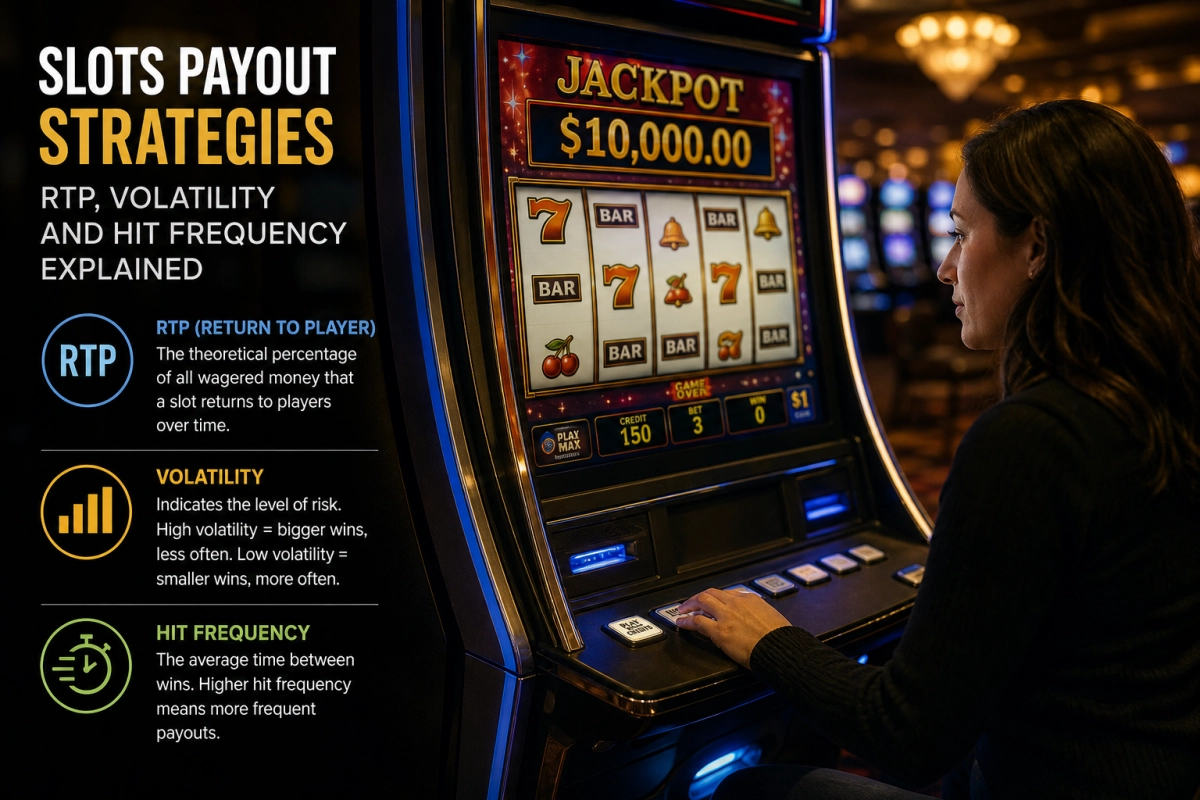
Return to player, commonly called RTP, is the theoretical percentage of all wagers that a slot returns as winnings over a very large number of spins. A slot with 96% RTP has a theoretical return of 96 units for every 100 units wagered across an extremely long run. The remaining 4% represents the mathematical house edge.
For example, if a player makes 1,000 spins at TSh 500 each, the total amount wagered is TSh 500,000. A 96% RTP would suggest a theoretical return of TSh 480,000 across comparable long-term play. It does not mean that the player will receive exactly TSh 480,000 in one session, or that any particular sequence of spins will be profitable.
- RTP: Indicates the game’s long-term theoretical return.
- House edge: The mathematical portion retained by the casino over time.
- Short-term results: Can differ significantly because individual spins are unpredictable.
Some online slots may also be available in different RTP versions. The displayed information, paytable and casino terms should therefore be checked before play. A higher RTP can be useful for comparison, but it does not remove variance or guarantee a positive session.
RTP, Volatility and Hit Frequency Are Different Measures
RTP alone does not describe how payouts are distributed. Volatility, sometimes called variance, describes the typical size and pattern of wins. A low-volatility slot may produce smaller payouts more regularly, while a high-volatility slot may offer less frequent wins with greater potential variation. High volatility can cause a bankroll to decline quickly when larger payouts do not occur.
Hit frequency measures how often spins produce any payout. A hit can be smaller than the original stake, so a high hit frequency does not necessarily mean frequent profit. For example, two games may both have 96% RTP:
- Game A: More frequent small wins, possibly making a modest bankroll last longer.
- Game B: Fewer wins, but a larger share of its RTP may come from occasional bonus rounds or major combinations.
These games can feel completely different despite having identical theoretical RTP. A player seeking longer sessions may prefer lower volatility, while someone comfortable with larger fluctuations may examine higher-volatility games—but only with money that can be lost.
Next, the guide examines paylines, paytables and bonus features, which help explain where a slot’s advertised payouts actually come from.
How Paylines and Paytables Affect the Advertised Payout
Paylines determine which symbol combinations can produce a win. In a traditional slot, a payline may run across matching positions from left to right. Modern games may use ways-to-win systems, cluster pays or other arrangements instead. The number of paylines does not automatically make a game more generous; it changes how winning combinations are evaluated and how much a complete spin costs.
For example, a slot with 20 paylines played at TSh 50 per line costs TSh 1,000 per spin. If the same game is played at TSh 100 per line, the total stake becomes TSh 2,000. A player should therefore check the total bet, not only the value shown for each line. Some games allow players to reduce the number of active lines, but doing so may prevent certain combinations from paying or may alter the game’s displayed features.
The paytable explains symbol values, wild and scatter functions, bonus triggers and any special winning rules. A listed reward such as “100x” usually refers to the bet used for the relevant line, way or feature, rather than providing 100 times an unlimited amount. Reading these details helps prevent a player from confusing a maximum win with a typical outcome. The maximum win is an upper limit under specific conditions, not a normal expectation for each session.
Bonus Features Can Change the Shape of a Slot’s Returns
Free spins, multipliers, expanding wilds, pick-and-win rounds and jackpots can make a slot more engaging, but they also affect how payouts are distributed. In some games, a substantial portion of the theoretical RTP is concentrated in bonus rounds. This can create long periods of ordinary play followed by a larger feature result, particularly in a high-volatility game.
Suppose a slot has a 96% RTP, but much of that figure comes from free spins. A player who does not trigger the feature during a short session may receive results well below the theoretical average. Another player may enter the feature early and finish with a much higher balance. Neither outcome proves that the game is due to pay or has become more generous; both are possible short-term variations around the same mathematical design.
Players should inspect the conditions attached to bonuses. A feature may require three or more scatters, pay different amounts depending on the chosen stake, or include special rules for retriggers and multipliers. Promotional casino bonuses can also have wagering requirements separate from the slot’s own rules, so those terms should be understood before funds are deposited or withdrawn.
Using Bet Size to Control Session Length and Bankroll Pressure
Bet sizing is one of the few practical choices a player can control. A larger stake may increase the value of a winning combination, but it also consumes the bankroll more quickly when spins lose. A smaller stake does not improve RTP or guarantee a win; it simply allows more attempts with the same budget and may reduce the impact of a losing sequence.
For example, a player with TSh 20,000 could make 40 spins at TSh 500, or 20 spins at TSh 1,000. If the slot experiences a run of losses, the second approach reaches the budget limit sooner. A player intending to play for entertainment might set a fixed loss limit of TSh 20,000, choose a stake that supports the desired session length and stop when that limit is reached. Wins should not automatically be recycled into larger bets, and a separate amount should be kept for essential expenses.
Making More Informed Slot Decisions
Understanding slot mathematics cannot predict the next spin, but it can make expectations more realistic. A clear budget, a suitable bet size and a willingness to stop are more dependable than claims about timing, streaks or guaranteed strategies.
Slots should remain entertainment rather than a way to meet financial needs. If play becomes difficult to control, taking a break and seeking appropriate support is more important than trying to recover losses.