
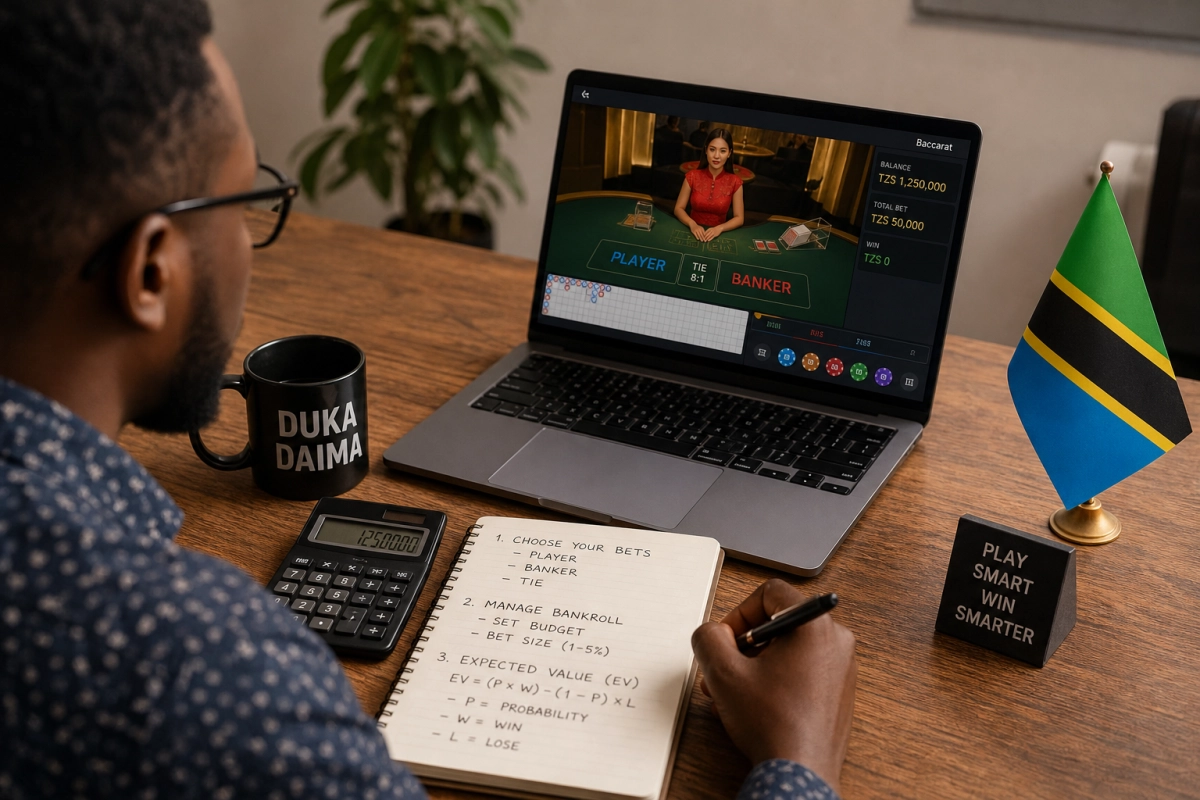
Practical guide to online baccarat for Tanzanian and Swahili-speaking players
This guide explains online baccarat in plain language and shows how to choose bets, manage your bankroll and calculate expected value (EV). It is written for Tanzanian and Swahili-speaking players who want practical, realistic tools — including how banker commissions, no‑commission variants and tie payouts change the math. In this first part you will learn the game basics, the main betting options and the key probabilities you need before applying bankroll rules or calculating EV with real‑world TZS examples.
How online baccarat works: objective, card values and basic play
Baccarat is a simple comparing game between two hands: the Player and the Banker. Each round players bet on which hand will have a total closest to 9, or on a Tie. Online baccarat uses electronic dealing or live‑dealer streams; the rules and payout math are the same across both formats.
- Card values: Aces = 1, 2–9 = face value, 10/J/Q/K = 0. Totals use only the last digit (e.g. 15 → 5).
- Objective: Bet on which hand totals 9 (or is closer to 9) after any drawing rules are applied.
- Drawing rules: Predefined rules decide third cards for Player/Banker; players do not make decisions after betting.
Step-by-step play (what to expect online)
- Place a bet on Player, Banker or Tie before the round starts.
- Two cards are dealt to Player and Banker and totals calculated.
- If required by the drawing rules, a third card is dealt to one or both hands.
- Payouts are made after comparing final totals; ties usually push bets.
Main bets, payouts, commissions and basic probabilities
Knowing each bet’s payout and probability is essential for EV and bankroll planning. Using standard 8‑deck figures (approx.): P(Banker) = 0.4586, P(Player) = 0.4462, P(Tie) = 0.0952.
- Banker bet: Usually pays 1:1 minus commission (commonly 5%). With 8 decks and 5% commission, house edge ≈ 1.06% — the lowest common edge.
- Player bet: Pays 1:1 with no commission; house edge ≈ 1.24% on 8 decks.
- Tie bet: Pays typically 8:1 or 9:1. With tie probability ≈ 9.52%, an 8:1 payout yields a large house edge (~14.4%); 9:1 improves it (~4.8%).
Variants: some casinos offer reduced or altered commissions (e.g., banker‑6 pays half). These rule changes change EV — always check the exact table rules and deck count before betting.
Quick expected value idea
EV is the average long‑term return per unit staked. Example: a 1,000 TZS bet on Banker with −1.06% house edge has expected loss ≈ 10.6 TZS; average return ≈ 989.4 TZS. EV = stake × (1 − house edge).
Step‑by‑step EV calculations with Tanzanian Shilling examples
Use the standard probabilities above (P(Banker)=0.4586, P(Player)=0.4462, P(Tie)=0.0952) to compute EV per unit:
- Banker (5% commission): Win nets 0.95, loss −1, tie 0. EV = 0.4586×0.95 + 0.4462×(−1) + 0.0952×0 = −0.01058 (≈ −1.058%). Example: 1,000 TZS ⇒ expected return ≈ 989.42 TZS, loss ≈ 10.58 TZS.
- Player: Win +1, loss −1, tie 0. EV = 0.4462×1 + 0.4586×(−1) + 0.0952×0 = −0.0124 (≈ −1.24%). Example: 1,000 TZS ⇒ expected loss ≈ 12.35 TZS.
- Tie: For tie probability ≈ 0.0952: at 8:1 payout EV = 0.0952×8 + 0.9048×(−1) = −0.1436 (≈ −14.36%); at 9:1 EV ≈ −0.0484 (≈ −4.84%). Example: 1,000 TZS tie at 8:1 → expected loss ≈ 143.6 TZS.
Conclusion from the math: Banker is the best steady default in standard games because it minimizes house edge. Convert EV per unit to TZS by multiplying by your stake.
Comparing no‑commission and reduced‑commission variants
No‑commission offers often change payouts for specific outcomes (common rule: Banker wins with total 6 pays half). To compare, adjust the EV to subtract the half‑payout probability:
EVno‑commission = P(Banker wins)×1 − P(Banker wins with total 6)×0.5 − P(Player wins)×1
Example: if P(Banker‑6) ≈ 0.046 then EV ≈ 0.4586 − 0.5×0.046 − 0.4462 = −0.0107 (≈ −1.07%). Depending on the exact P(Banker‑6) and deck count, the no‑commission tweak can be similar to or slightly worse than the standard 5% commission. Practical steps: check the variant wording and deck count, or test briefly at low stakes to confirm advertised math.
Session sizing and bankroll rules for Tanzanian players
Simple bankroll rules help avoid catastrophic losses and make play sustainable. Use unit sizing and session limits in TZS:
- Unit size: 0.5–1% of bankroll per bet. Example: 200,000 TZS bankroll → 0.5% = 1,000 TZS; 1% = 2,000 TZS. Smaller bankrolls should use the lower end.
- Session limits: Set stop‑loss and stop‑win before you start. Common ranges: stop‑loss 3–5%, stop‑win 5–10% of bankroll. Example: 200,000 TZS → stop‑loss 5% = 10,000 TZS; stop‑win 10% = 20,000 TZS.
- Rounds and exposure: Decide number of rounds. If you bet 1,000 TZS on Banker for 100 rounds, theoretical loss ≈ 100×10.58 TZS = 1,058 TZS. Variance can exceed expectation short term, so limit exposure accordingly.
- Table minimums and bonuses: Ensure minimum bets match your unit size; read wagering rules for bonuses as they affect effective EV.
Behavioral rules: avoid chasing losses, prefer Banker for steady expectation, and log outcomes in TZS to compare against EV. These controls help manage risk and keep play entertainment‑focused.
Real‑world session examples (TZS)
Three short session examples using Banker house edge ≈ 1.058% show how expected loss scales with stake and rounds.
-
Conservative session
Bankroll: 200,000 TZS. Unit = 0.5% = 1,000 TZS. Plan = 100 rounds on Banker. Expected loss per bet ≈ 10.58 TZS; session ≈ 1,058 TZS (≈ 0.53% of bankroll). Suggested limits: stop‑loss 5% = 10,000 TZS; stop‑win 8% = 16,000 TZS.
-
Moderate session
Bankroll: 50,000 TZS. Unit = 1% = 500 TZS. Plan = 200 rounds on Banker. Expected loss per bet ≈ 5.29 TZS; session ≈ 1,058 TZS (≈ 2.12% of bankroll). Suggested limits: stop‑loss 5% = 2,500 TZS; stop‑win 10% = 5,000 TZS.
-
One‑off tie bet example (risk reminder)
A 1,000 TZS tie bet at 8:1 payout has EV ≈ −14.36%: expected loss ≈ 143.6 TZS per tie bet. Tie bets are for occasional thrills but are much worse mathematically than Banker or Player.
Practical checklist before you play
- Confirm the exact variant, banker commission or special rules (e.g., half‑payout on banker 6) — these change EV.
- Set unit size (0.5–1% recommended) and stick to it.
- Decide session stop‑loss and stop‑win in TZS before you start.
- Match table minimums to your unit size and avoid tables that force oversized bets.
- Prefer Banker for the best steady expectation; avoid frequent tie bets unless you accept the higher house edge.
- Log outcomes in TZS to compare real results against theoretical EV and detect mistakes.
- Treat play as entertainment; never wager money you cannot afford to lose. Follow local gambling laws and age restrictions.
Practical next steps for responsible, informed play
Before you bet, verify the exact rules at the site and set clear, TZS‑based session limits. Use the unit and stop limits that match your bankroll and temperament, prefer Banker for steady expectation, and reserve high‑payout bets as occasional entertainment only. Keep records of your sessions, check your results against the EV math shown above, and adjust unit size if variance is affecting your bankroll more than expected. Play responsibly, know the local regulations, and enjoy the game as a managed form of entertainment rather than a way to earn income.