
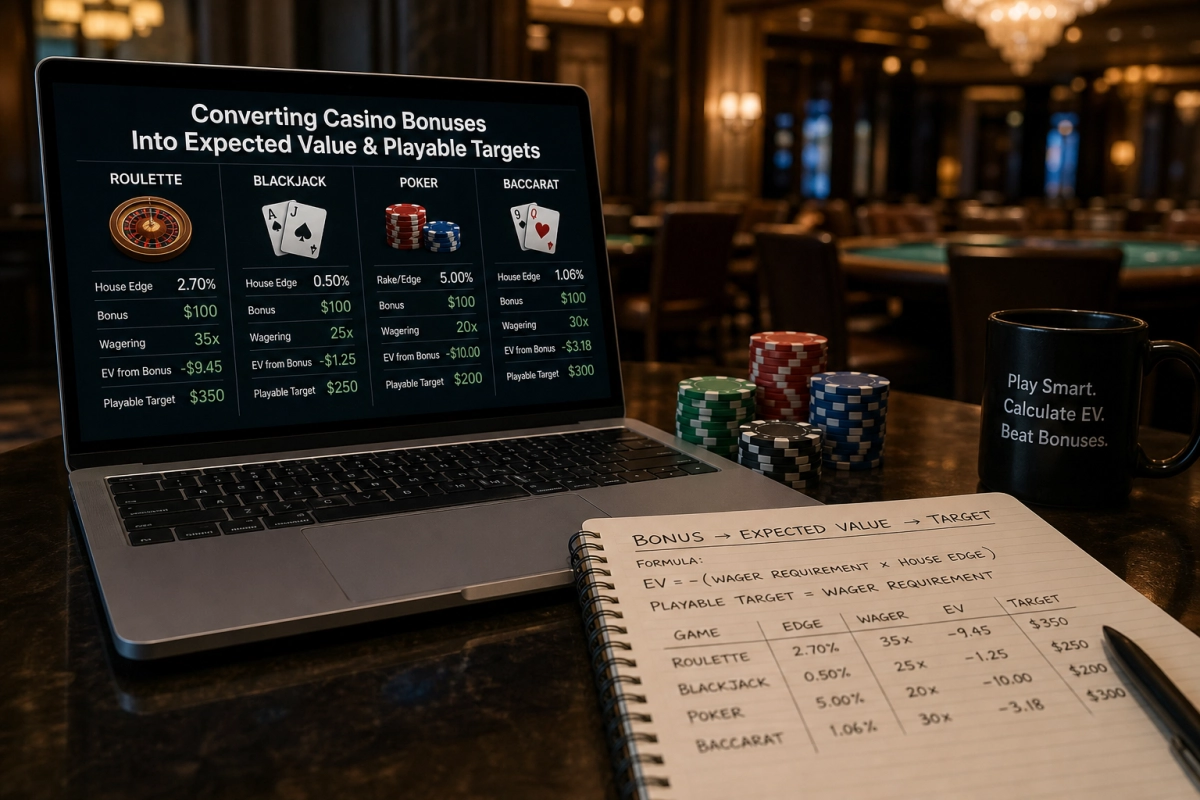
Turn casino bonuses into a clear expected-value decision for roulette, blackjack, poker and baccarat
This guide explains how to convert common casino bonus terms—deposit matches, free bets, wagering requirements and game weightings—into simple numbers a player in Tanzania can use. Readers will learn the key terms, a step-by-step calculation to estimate the expected value (EV) of a bonus, and a practical test (break-even house edge) to decide which table game is best for clearing a bonus.
Key terms made simple
- Deposit match: The casino adds bonus money, often a percentage of the deposit (for example 100% up to TZS 100,000).
- Free bet: A bet provided by the casino. Some free bets return winnings only (stake not returned).
- Wagering requirement (WR): The number of times the deposit + bonus must be wagered before withdrawal (for example 30x).
- Game weighting: The percentage of each bet that counts toward the WR. Example: roulette might count 10% (0.10), blackjack 20% (0.20).
- House edge (HE): The average percentage of each wager the casino keeps (European roulette ≈ 2.7%, typical blackjack ~0.5–1% with basic strategy, baccarat banker ~1.06%).
- Expected value (EV): Long-run average result from using the bonus. Positive EV means a theoretical profit, negative EV means expected loss.
Step-by-step method to convert a bonus into EV and a playable target
- Calculate total wagering required: W = WR × (Deposit + Bonus). Example: deposit 100, bonus 100, WR 30x → W = 30 × 200 = 6,000.
- Adjust for game weighting: If the chosen game weight g = 0.10 (10%), required real-stake on that game = W / g. Example → 6,000 / 0.10 = 60,000.
- Estimate expected loss from required staking: Expected loss ≈ required_real_stake × HE. Example for European roulette HE = 2.7% → loss = 60,000 × 0.027 = 1,620.
- Estimate net EV of the bonus: EV ≈ Bonus − Expected loss. Example → 100 − 1,620 = −1,520 (negative EV).
- Compute break-even house edge: HE_break = Bonus / required_real_stake. If actual game HE < HE_break the bonus can be positive EV. Example HE_break = 100 / 60,000 = 0.00167 (0.167%).
Quick rules of thumb
- Low game weightings make bonuses harder to clear on that game: a 10% weight means ten times more real betting required than a 100% weight game.
- Games with a low house edge (good blackjack rules, baccarat banker bet) reduce expected loss and improve EV.
- Free bets usually have lower effective value than their face value because many return winnings but not the stake—adjust calculations accordingly.
These steps give a practical way to compare options: run the same calculation for roulette, blackjack, poker and baccarat with the casino’s stated weightings and house edges to see which produces the highest EV or the smallest expected loss.
Next, the guide will apply this method to game-specific examples—detailed calculations for European roulette, blackjack with basic strategy, poker (cash vs tournament) and baccarat—showing playable bet sizes and realistic bankroll targets.
Detailed example: European roulette versus blackjack (practical numbers)
Using the earlier baseline (Deposit 100, Bonus 100, WR 30× → W = 6,000) compare roulette and blackjack with common weightings.
– Roulette (g = 10%, HE ≈ 2.70%)
– Required real-stake = W / g = 6,000 / 0.10 = 60,000.
– Expected loss = 60,000 × 0.027 = 1,620.
– Net EV ≈ Bonus − Expected loss = 100 − 1,620 = −1,520 (large negative).
– Break-even house edge = 100 / 60,000 = 0.167% (0.00167).
– Playable bet sizing: if you plan 1,000 spins to clear the WR, bet size = 60,000 / 1,000 = 60 per spin. For even‑money bets (red/black) variance is moderate; treat this as a high-variance route.
– Bankroll target: roulette is high variance — use a bankroll of roughly 80–150× the single spin size to survive swings. With bet 60, that implies a bankroll ~4,800–9,000.
– Blackjack (g = 20%, HE ≈ 0.7% with basic strategy)
– Required real-stake = 6,000 / 0.20 = 30,000.
– Expected loss = 30,000 × 0.007 = 210.
– Net EV ≈ 100 − 210 = −110 (much better than roulette).
– Break-even house edge = 100 / 30,000 = 0.333% (0.00333).
– Playable bet sizing: using 1,000 hands → bet = 30,000 / 1,000 = 30 per hand. Blackjack’s lower variance allows steadier progression.
– Bankroll target: for blackjack with correct basic strategy, a bankroll of 40–80× the single-hand bet is a practical conservative target. With bet 30 → bankroll ≈ 1,200–2,400.
Takeaway: with these common weightings and realistic house edges, blackjack usually produces a far smaller expected loss and a much lower bankroll requirement than roulette. If the break-even HE (0.333% here) is above the actual game HE you can make the bonus positive EV — so seek blackjack tables with good rules (low HE).
When poker or baccarat can make sense — realistic expectations and targets
– Poker (casino poker, cash games or tables counted)
– Two situations matter: (A) poker counts 100% toward WR, or (B) poker has a low weighting or is excluded. If poker counts 100%: required_real_stake = W / 1 = 6,000.
– Poker is a skill game; expected outcome depends on your win-rate after rake. Example: if you reliably net +0.5% of your stake on average (post‑rake), expected player gain = 6,000 × 0.005 = 30. Net EV ≈ Bonus + Gain = 100 + 30 = 130 (positive).
– If you are a losing or breakeven player after rake, poker is a poor choice even at 100% weighting. Always convert your historical win-rate into the same units (percent of stake or currency/hour) and plug into Expected gain = required_real_stake × player_edge.
– Playable target and bankroll: poker requires a dedicated skill bankroll (often 100–300 buy-ins for cash-game comfort). Use conservative bankroll sizing based on average buy-in, not just the bonus math.
– Baccarat (common g = 10–20%, HE for banker ≈ 1.06%)
– Example with g = 10%: required_real_stake = 60,000; expected loss = 60,000 × 0.0106 = 636; EV = 100 − 636 = −536.
– Baccarat is lower variance than roulette but higher HE than good blackjack; it can be attractive only when weightings and HE combine to give HE_break above 1.06%.
– Playable bet sizing: using 1,000 hands → bet = 60 per hand; bankroll target for baccarat is typically 50–100× the single-hand bet due to shorter sessions and lower variance than roulette.
Practical rule: run the required_real_stake and HE_break calculation for each game using the casino’s exact weightings and the real HE (or your personal poker win-rate). That single comparison tells you which game minimizes expected loss or, if you’re skilled, turns a bonus into positive EV.
Putting the method into practice
Treat each bonus as a small investment decision: run the math before you play, start small while you test the assumptions, and be ready to change course if real conditions (weightings, rules, your win-rate) differ from the example. The calculation gives a clear yes/no signal and practical bet sizing; your job is to enforce it and to manage variance and time-based restrictions that the casino applies.
Quick practical checklist
- Confirm the exact wagering requirement, eligible games and weightings in the T&Cs before you deposit.
- Compute total W = WR × (deposit + bonus) and then required_real_stake = W / game_weighting for each candidate game.
- Calculate HE_break = bonus / required_real_stake and compare it to the actual house edge (or your poker win-rate). If actual HE ≥ HE_break, the bonus is negative EV.
- Adjust calculations for free bets that don’t return the stake and for any max-bet limits during the wagering period.
- Plan conservative bet sizes and an appropriate bankroll multiple to survive variance; test the sequence at very low stakes first.
- Track your real results (stakes, wins/losses, time spent) and re-run math if you observe consistent deviation from expected figures.
- Stop pursuing the bonus if identity checks, delayed releases, or rule changes prevent you from completing the required play in a reasonable, low-risk way.
Responsible-play reminder
Bonuses can reduce the effective cost of play but are not risk-free or guaranteed profit. Only use funds you can afford to lose, set firm loss or time limits, and prioritise regulated operators with clear, enforceable terms. Use the method in this guide to make informed, disciplined decisions rather than chasing every offer.