
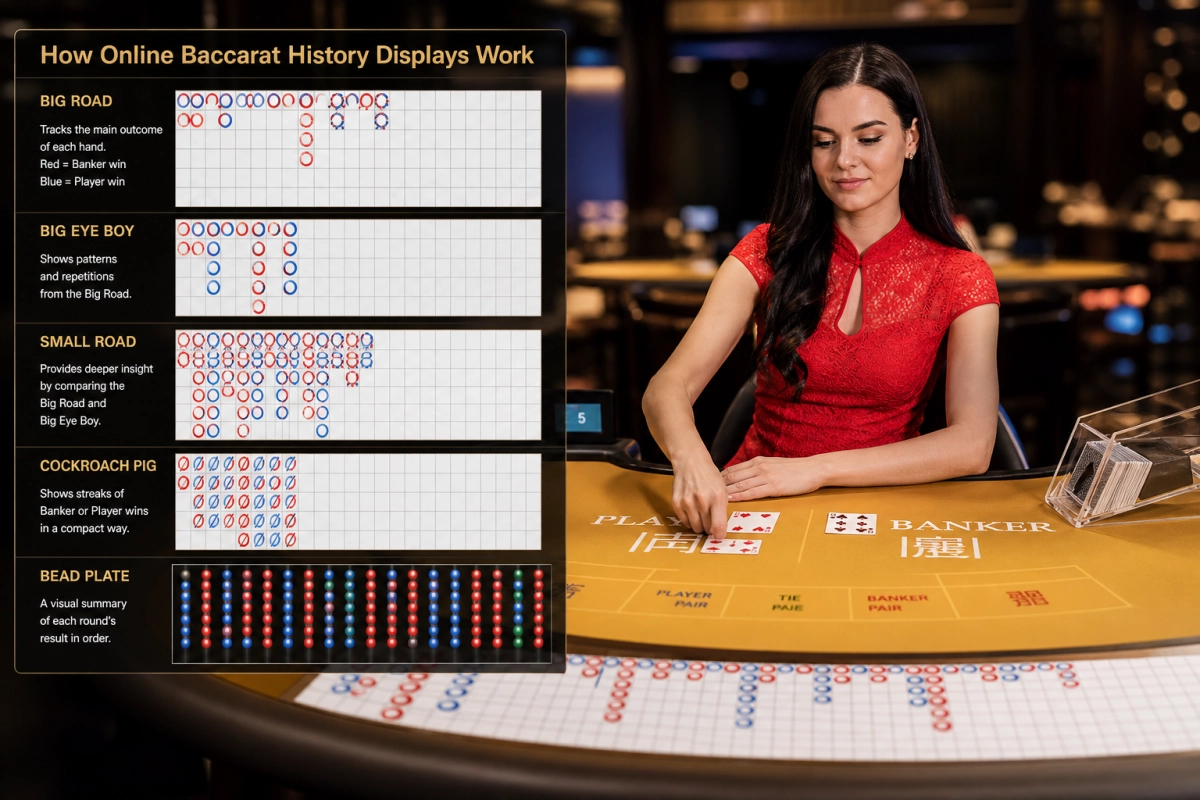
How online baccarat history displays show past results and what they mean
Online baccarat offers several popular history displays — the Big Road, Big Eye Boy, Small Road, Cockroach Pig and the bead plate — that record past round results visually. This guide explains what each board actually shows, how live-dealer and RNG histories differ, and introduces sensible ways to use these visuals when deciding bets. Readers will learn simple reading rules and the limits of pattern-based thinking before moving on to statistical and betting guidance.
Core history boards explained: what the Big Road and bead plate show
Start with the two most obvious displays you will see in any online baccarat lobby.
Bead plate (Bead Road)
The bead plate is the simplest record. It lists every round in sequence, left-to-right, top-to-bottom, like reading a page. Common conventions:
- Colors: red = Banker win, blue = Player win, green (or special symbol) = Tie.
- Each cell may include the winning side and sometimes card totals or pairs (if the provider shows them).
- Use: quick chronological record — good for checking exact recent outcomes and card totals, not for forecasting.
Big Road (main roadmap)
The Big Road is the primary visual many players use. It compresses the same sequence into columns to highlight streaks and switches:
- When the same side wins repeatedly, markers stack downward in the same column (showing a streak).
- A change of winner starts a new column to the right.
- Ties are usually marked but do not always move the column; conventions vary by provider.
- Use: quickly spot streaks (long Banker or Player runs) and frequency of changes, but remember it is still just past outcomes.
Derived roads: Big Eye Boy, Small Road and Cockroach Pig — what they show at a glance
These three lesser-known displays are derived patterns calculated from the Big Road. They are designed to highlight structural features rather than list results.
- Big Eye Boy: A visual that compares recent columns in the Big Road to detect consistency or sudden change. It uses two colours to show “similar” or “different” patterns — not direct wins.
- Small Road: Built from the Big Road with a one-column shift; it highlights shorter repeating patterns and is also shown in two colours.
- Cockroach Pig (also called “Roach” or “Cockroach Road”): A simpler, high-contrast derived road that picks up even finer short-term irregularities.
Common points about these derived roads:
- They do not display which side won each round; instead they indicate pattern stability (usually with red/blue or dark/light markers).
- Different software providers may label colours and tie rules differently — always check the legend in the game UI.
- These boards appeal to players who look for repeating structures, but they only encode transforms of the same past data shown in the Big Road.
Having clarified what each history board visually represents, the next section will compare how live-dealer and RNG game history is generated and explain the statistical limits of using these displays to guide betting decisions.
How live-dealer and RNG histories are produced — what’s identical and what differs
Live-dealer and RNG (algorithmic) baccarat both present the same set of history boards, but the underlying mechanics that create those boards differ in ways that matter for interpretation.
Live-dealer tables record actual physical cards dealt from a shoe (or a continuous shuffler). That means:
– Results reflect non-replacement card draws within a shoe: as the shoe is dealt the remaining card composition changes subtly, so the probability of certain outcomes shifts slightly mid-shoe.
– Shoe breaks and reshuffles create natural boundaries. Many casinos show a new bead plate/Big Road column after a fresh shoe, and some derived roads may reset or show discontinuities.
– Ties, pair information and commissions are based on real outcomes and the way the dealer/operator marks them — conventions (for example whether a tie advances the column) can vary.
RNG tables generate outcomes using a pseudorandom number generator. Different providers simulate either:
– Independent hand-by-hand outcomes (more like dealing with full shuffling after every hand), or
– A simulated shoe (a predetermined randomized deck sequence that is “dealt” until a virtual cut-card or reshuffle occurs).
RNG-generated histories may therefore behave like continuous fully shuffled hands (independence) or mimic physical-shoe dependencies, depending on implementation. Be aware that RNG history can be reset when the server or game instance restarts, which can create apparent discontinuities.
What’s the practical difference?
– In live-dealer games, short-term conditional probabilities can be slightly informative because cards are not replaced. In many online live tables the effect is small but real, especially late in a shoe.
– In RNG games that reshuffle every hand, each round is independent and past outcomes provide no informational advantage for predicting the next hand.
– Always check the game rules or help panel to see whether the site is simulating a shoe or using hand-level RNG.
Statistical limits of the roads and how to interpret what they do (and do not) tell you
The roads are visual transforms of past outcomes — useful for spotting superficial structure but limited statistically.
Key limitations:
– Independence and the gambler’s fallacy: each baccarat hand (in most online settings) is effectively independent of previous hands. Long runs, sudden switches and repeating motifs happen naturally in random sequences; they do not imply a causal mechanism you can exploit.
– Lag and loss of information: derived roads (Big Eye Boy, Small Road, Cockroach Pig) intentionally abstract the Big Road and use lagged comparisons. They signal pattern-stability, not who won which round, and often require several rounds before they register a change — so they are reactive, not predictive.
– Sample size and noise: short histories (dozens of hands) are overwhelmingly noisy. Apparent “biases” are usually sampling variation; statistical tests require large samples to confirm any real deviation from expected probabilities.
– Provider inconsistencies: color keys, tie handling and whether shoe boundaries are shown vary by software vendor; misreading the legend can lead to false conclusions.
Responsible readers should therefore treat roads as descriptive dashboards — they summarize what happened, give texture to the session, and can make play more engaging — but they do not materially change the house edge or guarantee predictive value.
Using history displays responsibly when placing bets
Apply practical rules rather than systems that chase patterns.
– Know the game type: check if you’re on live shoe, continuous shuffler, or RNG hand-by-hand mode. Adjust your expectations of dependence accordingly.
– Use history for context, not prophecy: let the boards inform you which shoes are recent or whether the table suits your style (e.g., many rapid Banker wins), but don’t treat them as a predictive engine.
– Manage bankroll and bet sizing: use flat bets or a small fixed percentage of your bankroll. Avoid escalating stakes based on perceived “due” outcomes.
– Limit session time and losses: set stop-loss and take-profit limits to prevent tilt from chasing patterns.
– Verify settings and legends: confirm how ties and pairs are displayed and whether derived roads reset at shoe breaks.
In short: read the roads to understand past flow and for entertainment value, but combine that with sound money management and an understanding of the statistical limits before letting history influence your bets.
Closing guidance for safe, informed play
Treat baccarat history displays as tools for context and engagement, not as guarantees or shortcuts to profit. The visual roads can make sessions more interesting and help you confirm a table’s recent flow, but they do not change the underlying mathematics of the game. Keep a disciplined mindset, manage your risk, and let these boards enhance your experience rather than drive impulsive decisions.
Practical reminders
- Confirm the game mode before relying on history: live shoe, continuous shuffler, or RNG can change how informative past rounds are.
- Check the on-screen legend and shoe boundaries so you know how ties, pairs and resets are recorded.
- Use demo play to practice reading the Big Road and derived roads without financial pressure.
- Prefer simple stake plans (flat bets or a fixed small percentage of your bankroll) over escalation systems that chase patterns.
- Set session limits for time, losses and wins to avoid tilt and emotional betting.
- Remember that derived roads are reactive indicators of pattern-stability, not predictors; any perceived “system” should be treated skeptically.
- If gambling stops being fun or you struggle to stick to limits, seek help from responsible-gambling resources and consider self-exclusion tools offered by the operator.
Read the tables, enjoy the graphics, and play with caution: that combination keeps baccarat entertaining while protecting your bankroll and your judgment.