
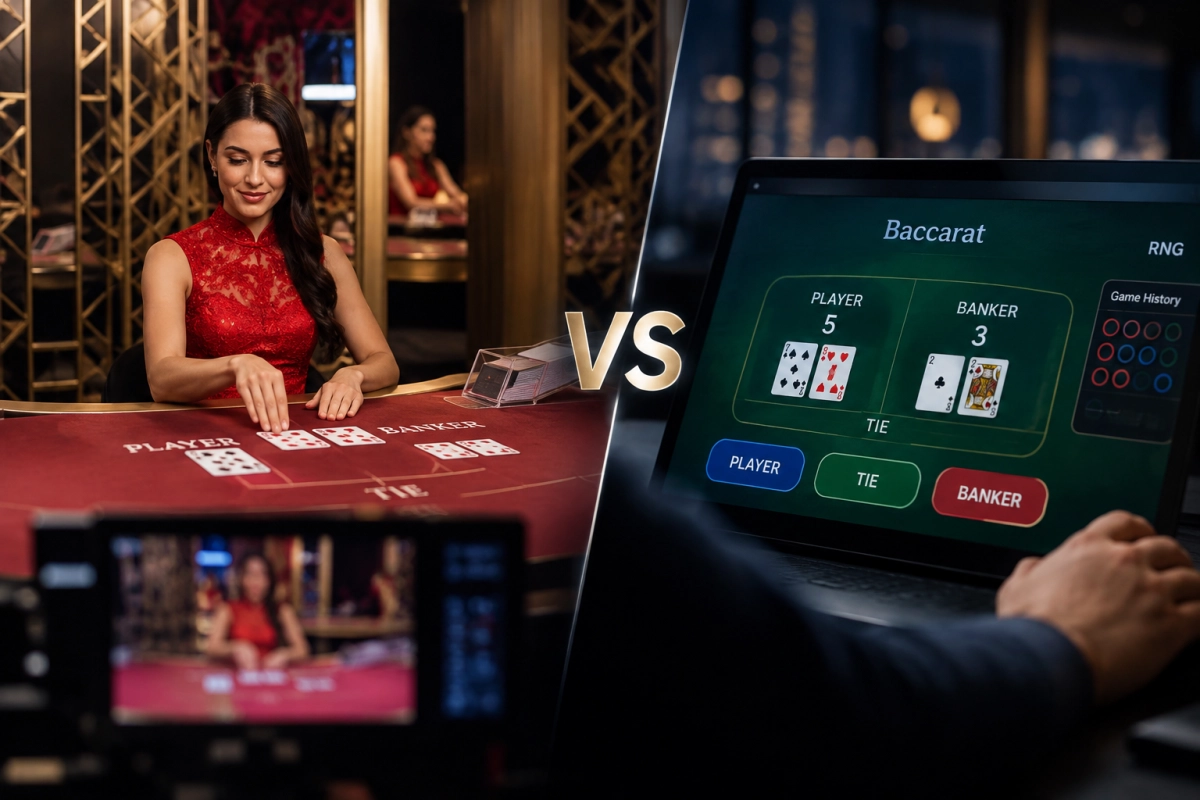
Live Dealer vs RNG Online Baccarat: A Practical Comparison
Choosing Between Live Dealer and RNG Online Baccarat
Online baccarat is available in two main formats: live dealer tables using physical cards and streamed dealers, and random number generator (RNG) games powered by casino software. Both formats follow the familiar baccarat objective: the player predicts whether the Player hand, Banker hand or Tie will have the final total closest to nine.
The main difference is how the result is produced and experienced. Live dealer baccarat provides a real table, human dealer and video stream, while RNG baccarat generates each result electronically. Neither format removes the mathematical house edge, so the more suitable option depends on factors such as preferred pace, betting budget, privacy and interest in a social casino environment.
How Each Baccarat Format Works
Live dealer baccarat
In a live game, a dealer sits at a physical table and deals cards from a shoe, which is a device holding several decks. Cameras transmit the table to the player’s screen. The betting window opens before the deal, and the software displays the available Player, Banker and Tie bets.
The game then follows standard baccarat drawing rules. Each hand receives two cards, and a third card may be dealt automatically according to the total and the relevant rules. Card values are simple:
- Aces count as one.
- Cards from 2 to 9 count at face value.
- 10s, jacks, queens and kings count as zero.
- Only the last digit of a total matters, so 7 and 8 equal 5.
The dealer does not choose whether to draw based on personal judgement. The third-card rules are fixed, helping keep the game consistent. Live tables may also offer chat, a history panel and a visual record of recent outcomes, although past results do not predict the next hand.
RNG baccarat
RNG baccarat uses certified software to select the outcome. The interface normally shows virtual cards, betting buttons and a countdown timer rather than a physical table. Once the wager is confirmed, the system reveals the result almost immediately.
This format is usually easier to access on a mobile connection and may allow a player to open a game without waiting for a seat. It also tends to provide more privacy because there is no dealer video or public chat. However, the experience is less immersive for players who enjoy watching cards being dealt in real time.
Speed, Betting Interfaces and Table Availability
Speed is one of the clearest practical differences. Live tables commonly deal around 40 to 80 hands per hour, depending on the number of players and the time taken for betting. Some rapid live or speed-baccarat tables can exceed 120 rounds per hour. RNG games can often complete hands much faster because there is no dealing, streaming or interaction delay.
- Live dealer: better for a measured pace, table atmosphere and observing a real dealer.
- RNG: better for private, quick sessions and immediate game availability.
- Interface: both formats normally show Player, Banker and Tie buttons, but live games may close betting while the dealer prepares the cards.
- Limits: RNG tables often offer lower minimum bets, while live tables may have wider limits but require a larger starting bankroll.
The next comparison will examine rules, payouts, fairness, odds and which format best suits different types of baccarat players.
Rules, Payouts and House Edge
Live dealer and RNG baccarat normally use the same underlying rules. The Player and Banker hands draw according to fixed third-card procedures, so the dealer’s presence does not change how the hand is resolved. The main variation is the specific table version. Players should check whether the game uses standard baccarat, commission baccarat, no-commission baccarat or a side-bet variant.
In standard baccarat, a winning Player bet usually pays even money, while a winning Banker bet pays 1:1 minus a 5% commission. The Banker bet is statistically stronger because of the drawing rules, even after commission is deducted. The Tie bet generally offers a much larger payout, often 8:1 or 9:1, but its probability is considerably lower and its house edge is typically much higher.
These odds apply to both formats when the same rules and payouts are used. An RNG game is not automatically better value than a live table, and a live dealer does not make the Banker bet more favourable than the mathematics already allows. Side bets can differ widely between providers, so their payout tables and house edges deserve separate attention rather than being judged by the main baccarat bets.
Transparency, Verification and Game History
Live dealer baccarat offers visible dealing, which can make the process easier to follow. Players can watch the cards leave the shoe, see the result on the table and review the hand history shown by the platform. A reputable operator should also identify the software provider, display the applicable rules and use regulated equipment and procedures.
RNG baccarat cannot be observed in the same physical way, but it should use a tested random number generator. Independent testing laboratories assess whether the software produces results within expected statistical parameters. Licensing information, responsible gambling tools and clear terms are useful signs that a casino takes fairness seriously.
Neither format can use previous outcomes to predict the next hand. Streaks, alternating results and displayed roadmaps may describe what has happened, but they do not alter the probability of a new round. The practical difference is therefore one of verification style: live baccarat provides a visible dealing process, while RNG baccarat relies on software certification and audit standards.
Matching the Format to Different Player Preferences
Live dealer baccarat is often suitable for players who value atmosphere, routine and a social setting. The streamed table can feel closer to visiting a casino, particularly when the player enjoys watching the dealer, following the shoe and using the chat function. It may also appeal to players who prefer a slower pace that creates more time between decisions.
RNG baccarat may be a better fit for players who prioritise convenience and control over session speed. Lower minimum stakes can help those working with a smaller budget, while fast rounds suit short sessions. The format is also practical when a player wants privacy, uses a mobile device or does not want to wait for an available live seat.
For either option, the betting limit should be checked before play begins. A table that accepts a preferred wager but permits a much higher maximum may encourage larger stakes than planned. Setting a budget, choosing a fixed bet size and avoiding the Tie bet as a recovery strategy are sensible safeguards regardless of whether the cards are dealt by a person or generated by software.
Making a Sensible Baccarat Choice
The best baccarat format is the one that fits a player’s preferred pace, budget and playing environment. Treat the choice as a matter of convenience and experience rather than a way to overcome the built-in house edge.
Before joining a table or launching an RNG game, check the rules, payouts, minimum stakes and operator credentials. Set a spending limit in advance, play only with money intended for entertainment and step away when the session no longer feels controlled.