
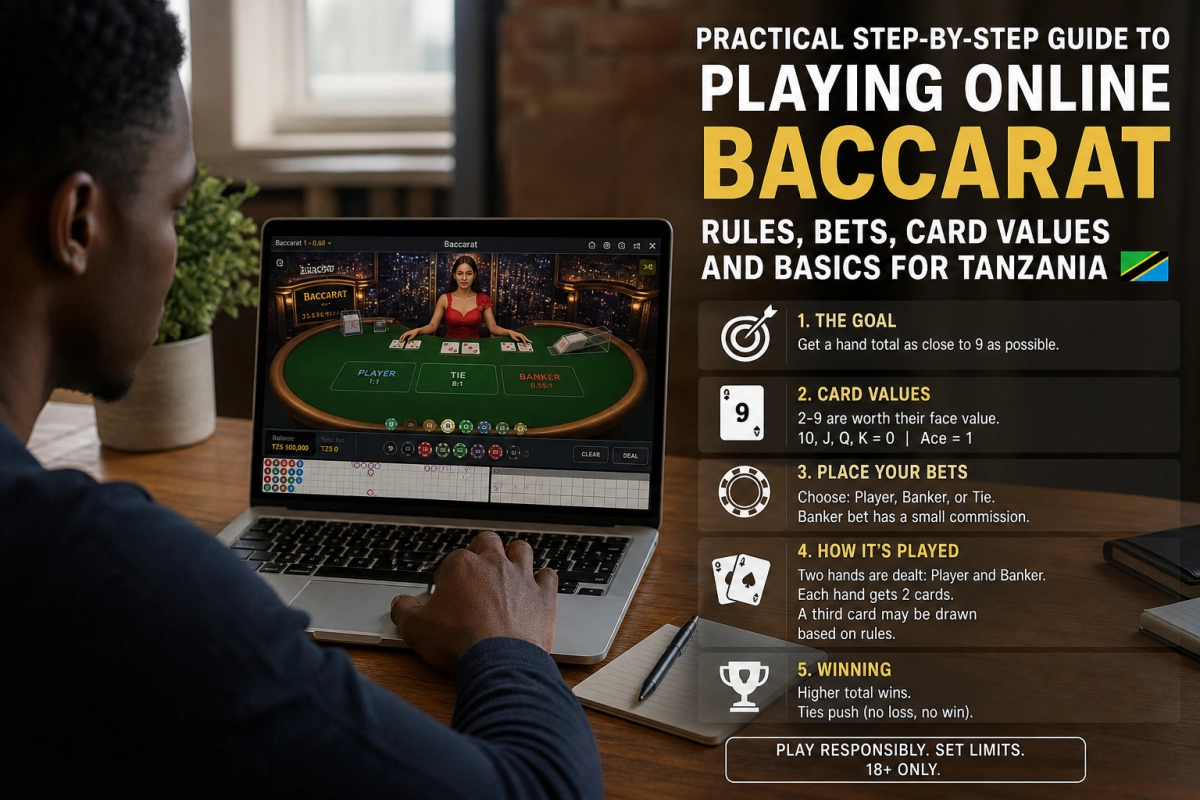
Learn online baccarat: what it is and what you will learn here
Online baccarat is a simple banked casino game where you bet on which hand — Player or Banker — will be closer to a total of 9, or whether the round will end in a Tie. This guide is written for adults in Tanzania and other Swahili-speaking markets who want a clear, step-by-step explanation: rules, bet types, card values, drawing rules, commission effects, house edge and quick comparisons of live dealer versus RNG tables. Practical tips for beginners and responsible bankroll advice are included in later sections.
How online baccarat works and the main objective
The casino deals two hands each round: the Player hand and the Banker hand. You place a bet before cards are dealt on one of three main outcomes:
- Player — bet that the Player hand wins (payout 1:1)
- Banker — bet that the Banker hand wins (payout 1:1, usually with commission)
- Tie — bet that both hands have the same total (higher payout, higher house edge)
Main objective: bet on which hand will finish closest to 9. If your chosen bet wins you are paid according to the table rules; if it loses you lose your stake.
Basic rules, card values and a quick example
Card values — simple scoring
- Ace = 1 point
- Cards 2–9 = face value (2 = 2 points, etc.)
- 10, J, Q, K = 0 points
- Hand total = sum of cards modulo 10 (only the last digit counts). Example: 7 + 8 = 15 → hand value 5.
How the round progresses (short step-by-step)
- Place your bet on Player, Banker or Tie before dealing.
- Dealer gives two cards to Player and two to Banker.
- If either hand totals 8 or 9 (a “natural”), no more cards are drawn and the higher hand wins.
- If no natural, the Player’s total determines if a third card is drawn: Player draws on totals 0–5, stands on 6–7.
- Banker drawing rules are more detailed: whether the Banker draws a third card depends on the Banker’s total AND the Player’s third card (if any). Dealers follow a fixed table of rules — players do not decide drawing.
- Payouts are made and the next round begins.
Bet types, commission effects and approximate house edge
Important numbers you should know (typical multi-deck shoe, common online rules):
- Banker bet: house edge ≈ 1.06% when a 5% commission is charged on wins (most common).
- Player bet: house edge ≈ 1.24% (no commission).
- Tie bet: house edge is high (≈ 14% with an 8:1 payout); many casinos offer 9:1 which slightly changes the math but still leaves a large house edge.
Note: some online casinos use no-commission banker variants or altered tie payouts. These change the house edge and the effective payout — always check the table rules before playing.
Next, the guide will walk through a full example hand, compare live dealer and RNG baccarat, explain common side bets and give practical beginner strategies and bankroll tips tailored to players in Tanzania and Swahili speakers.
Walkthrough: a full example hand (money math and drawing rules in practice)
To make the rules concrete, here is a realistic example using a common multi-deck shoe and a 5% commission on Banker wins.
– You place a Tsh 10,000 bet on Banker.
– Dealer deals: Player = 7 + 6 → total 3 (since 13 → 3). Banker = 4 + 2 → total 6. No naturals (8 or 9), so drawing rules apply.
Player drawing: Player has 3, so Player draws a third card (Player draws a 5 → new Player total = 3 + 5 = 8).
Banker drawing: Banker has 6. Whether Banker draws depends on Player’s third card. The standard Banker rule is:
– Banker 0–2: always draw
– Banker 3: draw unless Player third card was an 8
– Banker 4: draw if Player third card was 2–7
– Banker 5: draw if Player third card was 4–7
– Banker 6: draw if Player third card was 6–7
– Banker 7: stand
With Banker 6 and Player third card 5, Banker stands. Final totals: Banker 6 vs Player 8 → Player wins.
Money outcome: your Banker bet loses, you lose your Tsh 10,000 stake. If instead Banker had won, standard payout is 1:1 minus 5% commission on the winnings: a Tsh 10,000 winning Banker wager would return your stake + Tsh 9,500 profit (Tsh 10,000 × 0.95) → total Tsh 19,500. Ties push (your stake returned) on Player/Banker bets unless you specifically bet Tie.
This example shows why understanding the Banker drawing table matters; the dealer follows fixed rules, not strategy decisions by players.
Live dealer vs RNG baccarat: what to expect online
Live dealer baccarat streams real tables with human dealers; RNG (random number generator) baccarat uses software to deal simulated cards. Key differences:
– Experience: Live gives a social, authentic feel — you see a real shoe and dealer, good for players who want the land-based vibe. RNG is faster and more transactional.
– Speed & limits: RNG tables run many hands per hour and often accept much smaller minimum bets. Live tables are slower, may have higher minimums and limited seats.
– Transparency & trust: Reputable RNGs are certified and audited (look for eCOGRA, iTech Labs). Live tables still rely on operator trust and licensing; streams may show real shoe and cut card details for transparency.
– Practical considerations for Tanzanian players: check payment options (M-Pesa, TigoPesa, bank transfers), currency conversion and withdrawal times. Also check your operator’s license — prefer clearly regulated operators and those that offer Swahili support or local payment integration.
Common side bets, beginner strategies and bankroll tips (Swahili-friendly advice)
Common side bets include Player/Banker Pair, Perfect Pair, Dragon Bonus and Big/Small. These pay well on rare outcomes but carry large house edges — they are casino entertainment, not value plays.
Beginner strategies:
– Mathematically safest: bet Banker most of the time (lowest house edge). Player is acceptable; avoid Tie bets and most side bets.
– Flat betting: stake the same amount each hand. This reduces volatility and prevents chasing losses.
– Avoid pattern systems: streak-chasing or martingale can quickly bust your bankroll.
Bankroll management and responsible play (cheza kwa uwajibikaji):
– Set a session bankroll and wager units of 1–2% of that bankroll per hand. Example: Tsh 100,000 session bankroll → Tsh 1,000–2,000 bets.
– Use stop-loss and stop-win limits before you start; stick to them.
– Use site tools: deposit limits, reality checks and self-exclusion if available.
– If gambling causes stress, financial problems or affects family life, seek help and consider pausing play. Look for operator resources and local support groups; many sites offer Swahili-language help or guidance on setting limits.
Practice, table checks and quick pre-play checklist
Before staking real money, take a few small, practical steps to protect your bankroll and ensure a smooth experience:
- Use demo (free-play) tables to get comfortable with the pace and interface — especially for RNG games and for practicing wager timing on live streams.
- Check the table rules: number of decks, Banker commission, Tie payout, minimum and maximum bets. These details materially affect returns.
- Verify payment and withdrawal options relevant to Tanzania (M-Pesa, TigoPesa, bank transfers) and confirm currency handling and conversion fees.
- Confirm the operator’s license and responsible gambling tools (deposit limits, reality checks, self-exclusion). Prefer sites with Swahili support if you need help in your language.
- Inspect live tables for transparent dealing (visible shoe, cut card) if you value seeing the physical process; for RNG tables, look for laboratory certification badges from known auditors.
- Set your session bankroll and limits before you sit down to play — treat those limits as mandatory rules, not suggestions.
Final advice for safe and enjoyable play
Online baccarat is fast, simple and can be entertaining when approached responsibly. Keep your focus on managing risk rather than trying to beat the house, use demo play to build confidence, and always stick to predetermined bankroll and time limits. If playing in Tanzania, choose operators that support local payments and Swahili assistance, and check legal and licensing information before depositing funds. Above all, play for enjoyment — if it stops being fun or causes strain, pause and seek support. Best of luck at the tables, and cheza kwa uwajibikaji (play responsibly).