
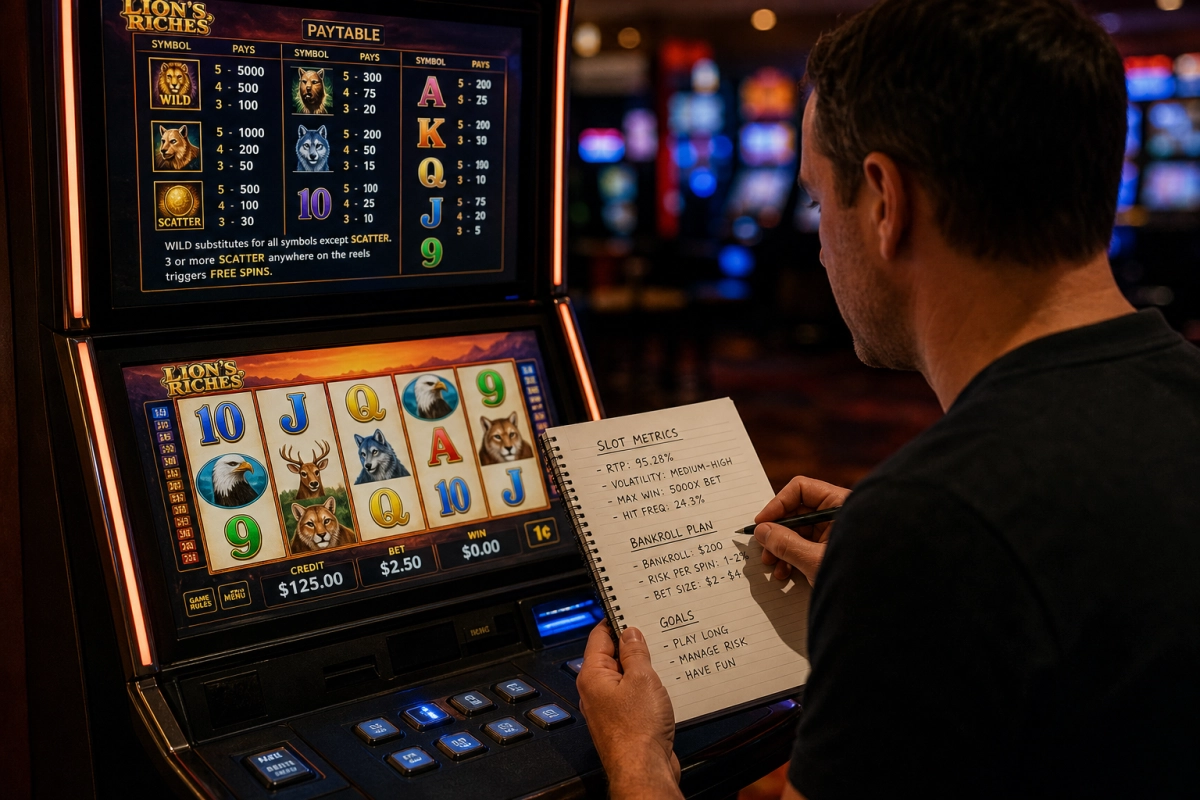
How to interpret slot machine metrics and protect your bankroll
This guide explains the slot metrics every beginner should know — RTP, volatility and hit frequency — and shows how to read paytables and bonus rules. It also gives simple, realistic slots payout strategies for bet-sizing and session rules that help manage risk and improve short-term outcomes. It does not promise to change the house edge; instead it focuses on informed decisions and responsible play.
Understanding RTP, volatility and hit frequency
Before placing bets, know these three terms:
- RTP (Return to Player): percent of wagered money a slot returns to players over a very large number of spins. Example: 96% RTP means the theoretical house edge is 4% (100% − 96%). RTP is a long-run average, not a guarantee for a single session.
- Volatility (variance): how big and how often wins occur. High volatility = larger, rarer wins and bigger swings. Low volatility = smaller, more frequent wins and steadier sessions.
- Hit frequency: how often a spin produces any kind of win (not necessarily a big one). A slot with 25% hit frequency pays a winning symbol combination about one in four spins on average.
Common mistakes beginners make:
- Assuming a high RTP means you will win in one short session. RTP is theoretical over millions of spins.
- Confusing volatility with RTP. Volatility affects variance, not the house edge.
- Choosing a machine only because it recently paid out (the “hot machine” fallacy).
Practical example of expected loss:
- If you place 100 spins at 100 TZS each (10,000 TZS total) on a 96% RTP game, the expected loss = 4% of 10,000 = 400 TZS. Actual results can be higher or lower in the short term due to volatility.
How to read paytables and bonus rules
Paytables and bonus rules tell you what the game actually pays and any conditions that matter for strategy.
Paytable checklist
- Look at symbol values and paylines: know the payout for 3, 4 and 5 symbols and whether the game pays both ways or only left-to-right.
- Check minimum and maximum bets shown on the paytable — some features require max bet to qualify for jackpots or multipliers.
- Understand special symbols: wilds, scatters and multipliers. Wilds substitute; scatters often trigger free spins.
Bonus rules to confirm
- Free spins: how many, average multiplier, and whether retriggers are possible.
- Bonus triggers: how many scatters are needed and on which reels they must land.
- Wagering requirements or cash-prize caps (in some promotions) and whether bonus wins are capped or paid in cash.
Reading these rules avoids surprises — for example, a game that advertises huge free-spin multipliers may only trigger them rarely or require a max bet to be eligible.
Simple bet-sizing and session rules to control risk
Apply straightforward bankroll rules rather than risky betting systems. Two practical rules:
- Set a session bankroll and bet size: use 1–3% of your available session bankroll per spin. Example: for a 50,000 TZS session, bet 500–1,500 TZS per spin.
- Use stop-loss and sell-high targets: set a loss limit (for example, 30–50% of session bankroll) and a modest win goal (20–50% gain). Walk away when either trigger hits.
Other tips:
- Adjust stake to slot volatility: lower bets on high-volatility games to extend playtime; higher bets are fine on low-volatility slots if it fits your bankroll.
- Avoid chasing losses with larger bets — increasing stake does not change RTP.
These measures are part of responsible slots payout strategies that manage variance and protect funds. They help short-term outcomes but do not change the machine’s mathematical house edge.
Next, the guide will show how to apply metrics and paytable details to choose machines, compare expected outcomes by bet level, and use simple calculators to model short-term risk and reward.
Choosing the right machine for your session goals
Pick a slot that matches what you want from a session — entertainment, steady small wins, or a shot at a big payout. Use RTP, volatility and hit frequency together, plus what you learned from the paytable and bonus rules:
- If your goal is longer playtime and smaller swings (stretching a small bankroll), choose lower-volatility games with higher hit frequency. Smaller, frequent wins keep your balance moving and reduce the chance of a quick bust.
- If your goal is chasing a large bonus or jackpot and you can accept big swings, pick higher-volatility games. Expect long dry spells; reduce your per-spin stake so you can survive until a bonus hits.
- If a bonus requires a max bet to qualify, only consider betting max if you can afford a realistic number of spins at that stake (see session-sizing below) and the bonus has reasonably frequent triggers according to the rules or published bonus frequency estimates.
Also compare paytables: a game might advertise big multipliers but have low scatter frequency or require specific reel positions. If a feature is rare, don’t inflate your stake expecting it soon — treat it as a low-probability event.
Compare expected outcomes at different bet levels
Use simple math to see how expected loss changes with bet size. Formula: Expected loss per spin = bet × (1 − RTP).
- Example: RTP 96% (house edge 4%). Bet 1,000 TZS → expected loss per spin = 1,000 × 0.04 = 40 TZS.
- For 100 spins at 1,000 TZS: expected loss = 40 × 100 = 4,000 TZS (or simply 100 × 1,000 × 0.04).
- Doubling the bet doubles the expected loss in absolute TZS, but does not change RTP or the long-term house edge.
Hit frequency helps set realistic expectations for short-term events. If hit frequency = 25% (p = 0.25), probability of at least one win in N spins = 1 − (1 − p)^N. Example: in 20 spins probability ≈ 1 − 0.75^20 ≈ 99.7% — you’ll almost certainly see some small wins, but not necessarily a big bonus.
Use simple calculators to model short-term risk and reward
You can build a quick hand calculator (phone or spreadsheet) with three inputs: bet, RTP, and planned spins. Steps:
- Compute expected loss: bet × spins × (1 − RTP).
- Estimate chance of at least one hit using hit frequency p: 1 − (1 − p)^spins (use this for features counted as a “win” event, e.g., any payout or bonus trigger if you know p).
- Decide a safety buffer: add 10–30% to the bankroll amount if playing high-volatility games or chasing rare bonuses.
Example plan: you want 200 spins, RTP 96%, bet 500 TZS. Expected loss = 500 × 200 × 0.04 = 4,000 TZS. If hit frequency = 20%, chance of at least one win ≈ 1 − 0.8^200 ≈ ~99.999% (small wins almost certain). Add a 20% buffer for volatility → required session bankroll ≈ (500 × 200) × 1.2 = 120,000 TZS.
These simple models won’t predict exact outcomes, but they turn abstract metrics into concrete numbers you can use to pick stakes, set stop-loss/win goals, and avoid risky decisions that don’t change the house edge.
Quick session checklist
- Decide your session bankroll and per-spin stake before you start (1–3% of the session bankroll is a practical range).
- Check the paytable and bonus rules for any max-bet requirements or capped payouts that affect your plan.
- Run a simple expected-loss calculation (bet × spins × (1 − RTP)) and add a volatility buffer (10–30%) to your required bankroll.
- Match stake size to game volatility and hit frequency so your bankroll can sustain the session you want.
- Set a stop-loss and a modest win goal, then stick to them — walking away is part of the strategy.
- Prefer practice/demo mode for unfamiliar games or when testing bet-sizing before risking real money.
Parting advice for practical, responsible play
Slots are designed for entertainment; the house edge is a built-in feature you cannot remove. Use RTP, volatility and paytable details as decision tools to manage risk and shape the kind of session you want, not as promises of profit. Practical bet-sizing, realistic stop-loss and win targets, and simple calculators turn abstract metrics into actionable limits that protect your bankroll and make sessions more predictable.
Keep records of stake, session length and results so you can learn what works for your goals. If play stops being fun or you feel pressure to chase losses, pause and seek support. With preparation, restraint and the right expectations, you can enjoy slot play while minimizing harm and making smarter short-term choices.