
How slots payout strategies work: what a beginner needs to know
This guide explains what “slots payout strategies” really are and what beginners should understand before pressing spin. Readers will learn clear definitions of Return to Player (RTP), volatility (variance), and hit frequency, and how bet size and bankroll management influence short‑term payouts. The goal is practical, realistic advice for planning short sessions rather than promising long-term wins.
Core terms that determine short‑term payouts
Before trying any strategy, it helps to define the main terms that affect how often and how much a slot pays in the short run.
Return to Player (RTP)
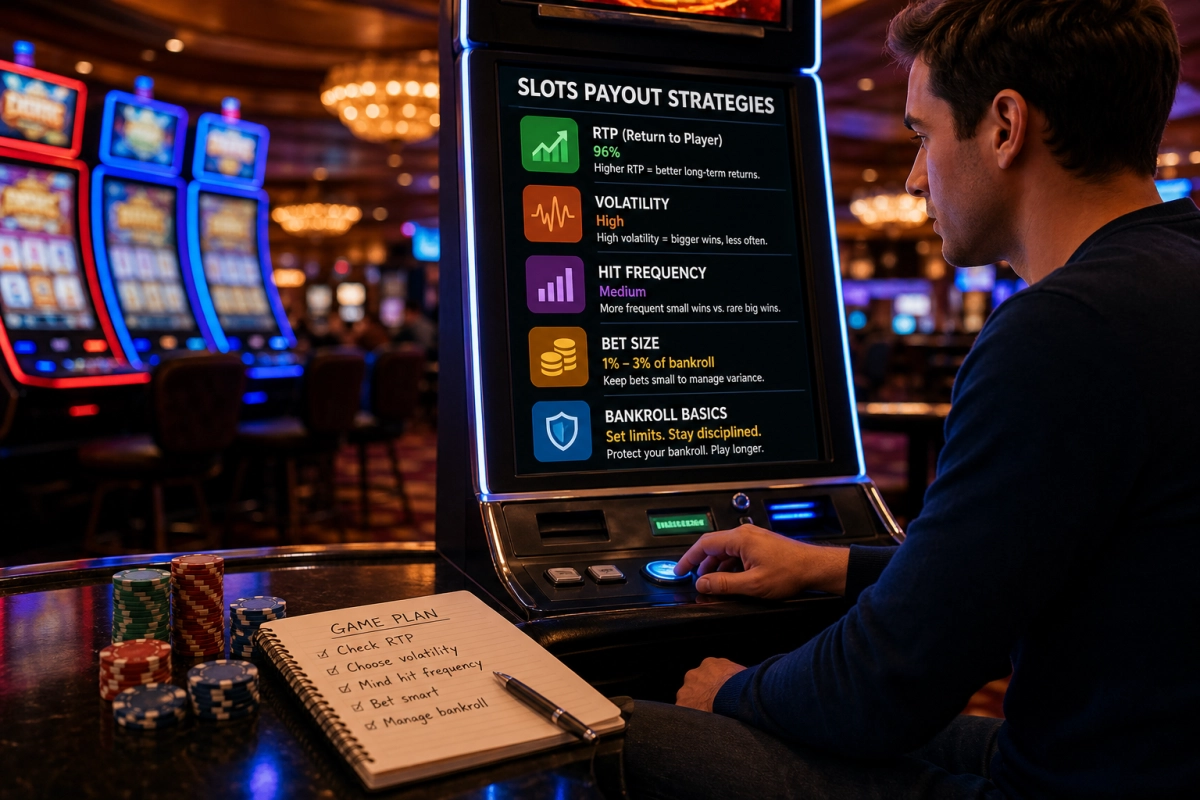
RTP is the percentage of wagered money a slot returns to players over a very long period. Example: a 96% RTP means that, on average over millions of spins, the game returns 96 units for every 100 staked. RTP is a theoretical long-term measure and does not predict what will happen in one session.
Volatility (variance)
Volatility describes how winnings are distributed over time:
- Low volatility: frequent small wins, steady bankroll changes.
- Medium volatility: a balance of small and occasional medium wins.
- High volatility: rare wins but larger payouts when they occur.
High volatility increases the chance of both big short-term gains and deep short-term losses. It does not change the game’s RTP.
Hit frequency
Hit frequency is the percentage of spins that produce any payout (even small ones). A high hit frequency means the player sees wins more often, which helps session feel less “dry” but those wins may be small. Hit frequency and volatility are related but not identical: two games can have the same RTP with different hit frequencies and payout sizes.
How RTP, volatility and hit frequency affect short‑term outcomes
Understand these simple relationships when planning bets:
- A high RTP reduces long-term expected loss but says little about what happens in a short session.
- High volatility increases the range of possible short-term outcomes: larger swings up or down.
- High hit frequency makes short sessions feel more stable, even if the RTP is unchanged.
Practical example
Play 100 spins at $1 on a slot with 96% RTP. The expected return is 96 units, so the theoretical loss is 4 units. In practice, variance means you might finish with 60 units or 140 units after 100 spins — both are realistic short‑term outcomes despite the same RTP.
Basic bet size and bankroll rules for beginners
Simple rules make short sessions manageable and reduce the chance of quick bankroll depletion:
- Decide a session bankroll (money set aside for one sitting) and never exceed it.
- Use small bet units: common beginner guidance is 1–3% of the session bankroll per spin. Example: with 10,000 units session bankroll, a 100–300 unit bet is conservative.
- Set a loss limit and a modest win goal. Stop when either is reached.
- Choose volatility to match goals: low volatility for longer, steadier play; high volatility for chasing larger but less frequent payouts.
These basics prepare a player to choose appropriate games and stake sizes. The next part will show realistic session plans, step‑by‑step examples using common bankroll sizes, and typical mistakes beginners make when applying slots payout strategies.
Realistic session plans with step‑by‑step examples
Below are simple, realistic session plans for three common bankroll sizes. Each plan follows the basic rules from earlier (1–3% bet units, pre‑set loss limit and modest win goal) and shows how many spins and what stop points make sense for short sessions.
Small session — 100 unit bankroll (casual, low‑risk)
- Bet size: 1 unit per spin (1% of bankroll).
- Session length target: 100–200 spins. At 1 unit per spin this keeps the session affordable and low variance in spending pace.
- Stop rules: loss limit = 30 units (stop if bankroll falls to 70); win goal = 30 units (stop if bankroll reaches 130).
- Why this works: small bets preserve playtime and let you experience the game’s hit frequency without risking big swings.
Medium session — 500 unit bankroll (balanced play)
- Bet size: 5 units per spin (1% of bankroll) or 10 units (2%) if you prefer slightly larger swings.
- Session length target: 200 spins at 5 units spends 1,000 units total waged (you can expect many spins without draining the bankroll if variance cooperates).
- Stop rules: loss limit = 100 units (stop at 400); win goal = 150 units (stop at 650).
- Why this works: the larger bankroll absorbs variance better, and adjustable bet size allows you to tune excitement vs endurance.
Longer session — 5,000 unit bankroll (targeting bigger features)
- Bet size: 50–150 units per spin (1–3%). Use 1% for long, steady sessions; use higher only if chasing larger bonus thresholds.
- Session length target: 500–2,000 spins depending on bet size and desired session duration.
- Stop rules: loss limit = 1,000 units (20%); win goal = 1,000–1,500 units (20–30%). Consider breaking the bankroll into multiple sessions to protect winnings.
- Why this works: bigger bankrolls let you play high‑volatility games that can pay big bonuses without immediate ruin, but still require disciplined stop limits.
General operating tips for any plan: set an absolute time limit (e.g., 60–90 minutes), don’t change bet size mid‑session unless rebuilding a smaller bank after a win, and account for bonus‑buy options (they dramatically change variance and should be budgeted separately).
Common mistakes beginners make (and how to avoid them)
Several predictable errors turn reasonable plans into quick losses. Recognising them helps you stick to realistic expectations.
- Chasing losses by increasing bet size (martingale). Why it fails: variance can produce long losing runs; raising stakes doubles down on risk. Better option: accept the loss limit and walk away or take a break.
- Confusing RTP with short‑term guarantees. Why it fails: RTP is long‑term; expect short sessions to vary widely. Better option: choose high RTP only as one factor, and match volatility to your bankroll/tolerance.
- Ignoring hit frequency and paytable. Why it fails: games with flashy big prizes may have tiny hit frequency; small bankrolls won’t last. Better option: check hit frequency indicators, sample free play, and read the paytable before betting real money.
- Using max bet blindly for features. Why it fails: some bonus triggers or multipliers require a max bet; others do not — blindly using max bet inflates risk. Better option: verify the game’s rules and budget any max‑bet requirements into your plan.
- Playing too long without breaks. Why it fails: fatigue harms judgement and increases impulsive decisions. Better option: schedule short sessions and enforce time limits.
Putting plans into practice
Action and discipline matter more than any single “strategy.” Use controlled, repeatable habits so your sessions stay predictable in behavior even if the spins are not.
- Decide a session bankroll and pre-set loss and win limits before you start — then stop when you reach them.
- Choose a bet unit (for example, 1–3% of your session bankroll) and avoid changing it impulsively mid‑session.
- Pick games that match your bankroll and goals: use lower volatility for sustained play and higher volatility only with an appropriately larger bankroll.
- Try games in demo mode first to observe how hit frequency and features feel without risking money.
- Set a strict time limit for sessions to reduce fatigue-driven mistakes and impulsive betting changes.
- Log basic session outcomes (duration, starting/ending bankroll, notable wins/losses) and review periodically to refine your approach.
- Never chase losses. If a session goes beyond your loss limit, walk away and reassess later.
- Treat slot play as entertainment with a budget — not a way to make money — and only gamble what you can afford to lose.
Keep the rules simple and enforceable. Over time, disciplined habits will protect your bankroll and keep slot play enjoyable even when luck swings. Above all, control what you can (stakes, limits, and time) and accept what you cannot (the randomness of each spin).