
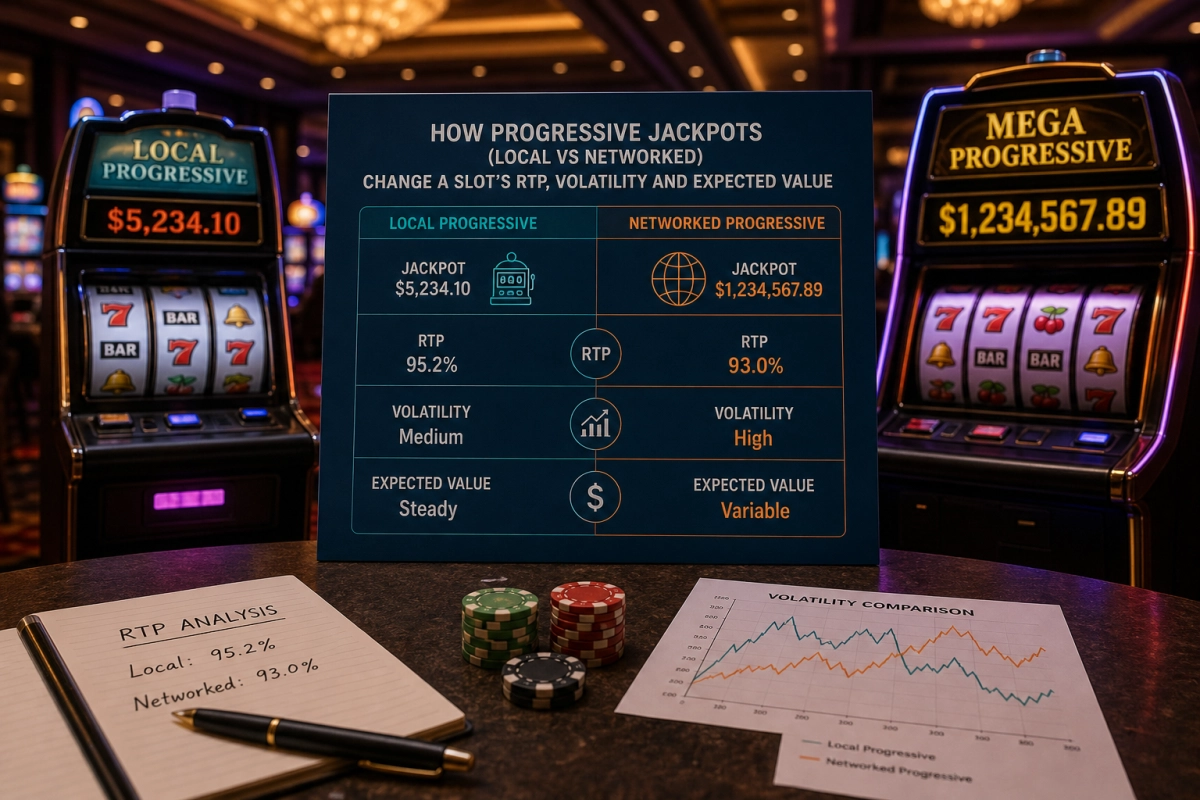
How progressive jackpots change a slot’s RTP, volatility and expected value
What a progressive jackpot is and the basics you must know
A progressive jackpot grows as players wager. Two common types are local progressives (single machine or casino pool) and networked progressives (many casinos sharing the same jackpot). Key terms:
- Contribution rate – percent of each bet added to the jackpot.
- Seeded jackpot – an initial amount the operator adds to start the jackpot.
- Base RTP – the slot’s return-to-player percentage excluding the progressive.
- Effective RTP – RTP after accounting for the contribution and the jackpot’s expected payout.
Local vs networked progressives — key differences
Local progressive:
- Smaller player pool and lower average jackpot, but higher hit frequency per pool size.
- Contribution may be higher to grow the jackpot within the smaller pool.
Networked progressive:
- Many players contribute, producing much larger jackpots (often seeded higher).
- Hit frequency per spin is typically lower, making volatility much higher though expected jackpot EV can be larger.
How contribution rates and seeded jackpots affect effective RTP — worked examples
A portion of each bet is redirected into the jackpot pool, reducing routine payouts but adding rare upside via jackpot EV.
Example assumptions:
- Base RTP (excluding progressive) = 96.0%
- Contribution rate = 1.0% of each bet
- Average bet = TSh 1,000
- Current jackpot = TSh 10,000,000
- Probability to hit jackpot per spin = 1 in 10,000,000 = 0.0000001
Summary calculation:
- Regular paybacks drop by contribution: 96.0% − 1.0% = 95.0%.
- Expected jackpot payout per spin = J × p = 10,000,000 × 0.0000001 = TSh 1 = 0.1% of a TSh 1,000 bet.
- Effective RTP ≈ 95.0% + 0.1% = 95.1%.
If the operator seeds the jackpot (e.g., + TSh 5,000,000), the expected jackpot EV rises and effective RTP increases slightly. Networked progressives often have higher J and rarer p, changing EV and volatility together.
Practical staking, session adjustments and common mistakes
Quick practical steps:
- Expected loss per spin = (1 − effective RTP) × bet. Using the example: (1 − 0.951) × 1,000 = TSh 49 per spin.
- Set session limits in spins or TSh. For 100 spins at TSh 1,000 expect ~TSh 4,900 loss (statistical expectation).
- Don’t increase stakes after losses; chasing rarely improves long‑term EV.
Common mistakes:
- Assuming contribution equals pure loss — ignore jackpot EV is wrong.
- Chasing jackpots after losses — increasing bets doesn’t change odds.
- Not checking whether the displayed RTP includes the progressive.
Volatility calculations — how a rare jackpot dominates variance
Volatility is driven by the jackpot’s large magnitude even when its EV per spin is small. Using bet = TSh 1,000:
- Regular expected return per spin (after contribution) ≈ TSh 950.
- Jackpot EV per spin ≈ TSh 1 (from J = 10,000,000 and p = 1/10,000,000).
- Total EV per spin ≈ TSh 951.
Variance is dominated by the jackpot term. For the example:
- Var_jack ≈ p × J^2 − (pJ)^2 ≈ 10,000,000 (TSh^2).
- SD_jack ≈ sqrt(10,000,000) ≈ TSh 3,162 per spin.
- If regular game SD ≈ TSh 500 (Var ≈ 250,000), total Var ≈ 10,250,000 → SD_total ≈ TSh 3,200 per spin.
Interpretation: a TSh 1 jackpot EV inflates per‑spin volatility many times over. For networked progressives with much larger J and much smaller p (but equal or larger EV), SD can be orders of magnitude higher, making session results much more spread out despite similar or higher EV.
How bonus‑round structures change hit frequency, effective RTP and staking advice
Bonus rounds (free spins, bonus games, multipliers) alter EV and volatility by changing trigger frequency and average payout size. Examples:
- Frequent bonus (q = 1/100) with B = TSh 2,000 → bonus EV per spin = 20 TSh (2% of TSh 1,000). This raises effective RTP and reduces relative volatility versus a single huge jackpot.
- Rare bonus (q = 1/10,000) with big average win = TSh 50,000 → EV per spin = 5 TSh but variance is large, increasing SD and the chance of long losing runs.
Practical staking guidance:
- For low SD games (SD per spin < 2× bet): max bet ≤ 2–5% of session bankroll.
- For high SD/networked progressive games (SD per spin > 3× bet): max bet ≤ 0.5–1% of session bankroll.
- Allocate a small portion (e.g., 5–10%) of overall bankroll for speculative jackpot chasing; don’t top up after losses.
Practical session plans and worked bankroll examples (in TSh)
Example A — conservative entertainment play
- Bankroll: TSh 200,000.
- Assumptions: local progressive, base RTP 96.0%, contribution 1.0% → regular RTP 95.0%; J = TSh 10,000,000, p = 1/10,000,000 → jackpot EV = TSh 1.
- Effective RTP ≈ 95.1%.
- Bet size: TSh 500. Expected loss per spin ≈ TSh 25. Planned 200 spins → expected loss ≈ TSh 5,000. Set stop‑loss TSh 30,000 and time limit 60 minutes.
Example B — small allocation for a jackpot chase
- Bankroll: TSh 500,000. Allocate 5% = TSh 25,000 for jackpot play.
- Assumptions: networked progressive, after contribution RTP ≈ 95.0%; J = TSh 50,000,000; p = 1/20,000,000 → jackpot EV = TSh 2.5.
- Bet size: TSh 2,000 (often required to qualify). Jackpot EV percent of bet ≈ 0.125% → effective RTP ≈ 95.125%.
- Expected loss per spin ≈ TSh 98. With TSh 25,000 you can afford 12 spins → expected total loss ≈ TSh 1,176. Keep chasing money small and fixed.
Common mistakes and quick fixes
- “Contribution is pure loss.” Quick fix: compute jackpot EV (J×p) and add to regular RTP.
- “Increasing bet after a loss improves chances.” Quick fix: odds are memoryless; stick to a stake plan.
- Ignoring hit‑eligibility rules. Quick fix: read machine rules—many jackpots require max bet or specific lines.
- Not checking whether displayed RTP includes progressives. Quick fix: ask the operator or check game help.
- Using entire bankroll for high‑variance games. Quick fix: split bankroll into entertainment + speculative allocations with strict limits.
Bankroll tips and session rules tailored for Tanzanian players
- Set a clear bajeti ya mchezo (game budget) in TSh and divide it into session units (e.g., ten sessions of TSh 20,000).
- Use percentage rules tied to volatility: low SD games → max bet ≤ 2–5% of session; high SD/networked progressives → max bet ≤ 0.5–1%.
- Set hard stop‑loss and a win target (e.g., stop after losing 15% of session or after winning 50% above session stake).
- Verify seeded jackpot details and treat temporary seeds as transient EV—don’t assume persistence.
- Keep records in TSh: spins, bets, time, net result to spot chasing behaviour early.
Responsible play — practical reminders (Kiswahili phrases included)
- Weka bajeti, ukamatwe na muda: set a budget and time limit; use built‑in casino limits.
- Avoid kufuatilia hasara (chasing losses); take a break or self‑exclude if needed.
- Usitumie pesa za muhimu (do not gamble essential money). Prioritise rent, food, school.
- Tafuta msaada: if gambling causes stress, reach out to family or local support services or use operator tools.
- Remember: jackpots are entertainment with tiny probabilities. Treat play as paid entertainment, not a plan to make money.
Final notes for Tanzanian players and operators
Progressive jackpots can be exciting and occasionally life‑changing, but they change the maths of every spin: a small contribution lowers routine payouts while the rare, large win dramatically raises volatility. Use the simple calculations above to convert advertised RTPs and jackpot displays into practical expectations in TSh. Keep stakes proportional to your bajeti, respect stop‑loss rules, and treat jackpot play as a small, separate entertainment allocation. Play only with licensed operators, use limits and reality checks, and prioritise your financial and emotional wellbeing over chasing jackpots. Happy and safe gaming—cheza kwa uwajibikaji.